
-800x600w.jpeg "Sorting out the difference between FACS and MACS")
Essential Tools in Cell Sorting for Modern Laboratories
In biomedical research, understanding cell populations is crucial for improving our knowledge of diseases, developing tests, and creating treatments. Two of the more essential methods in this area are Fluorescence-Activated Cell Sorting (FACS) and Magnetic-Activated Cell Sorting (MACS). These technologies enable researchers to obtain the selective isolation of cells by their physical and immunological properties, which can lead to advances in immunological, oncological, stem cell, and other fields.
While both FACS and MACS are involved in cell sorting, their approaches differ in how they work. Whereas FACS uses fluorescence-based detection, which provides high sorting accuracy, MACS uses magnetic detection, which is simpler and faster. Altogether, they are two methods working in parallel as tools that allow researchers to solve a range of experimental and clinical issues.
This article focuses on the working principles, uses, benefits, and drawbacks of FACS and MACS to provide an enlightening perspective of these techniques' salient position in contemporary laboratories.
Understanding FACS Technology
How It Works
The application of advanced cell sorting is called fluorescence-activated cell sorting (FACS), a development of the flow cytometry technique. FACS separates cells according to the fluorescence signal originating from the particular marker, allowing for the recognition and isolation of different subsets in the mixture.
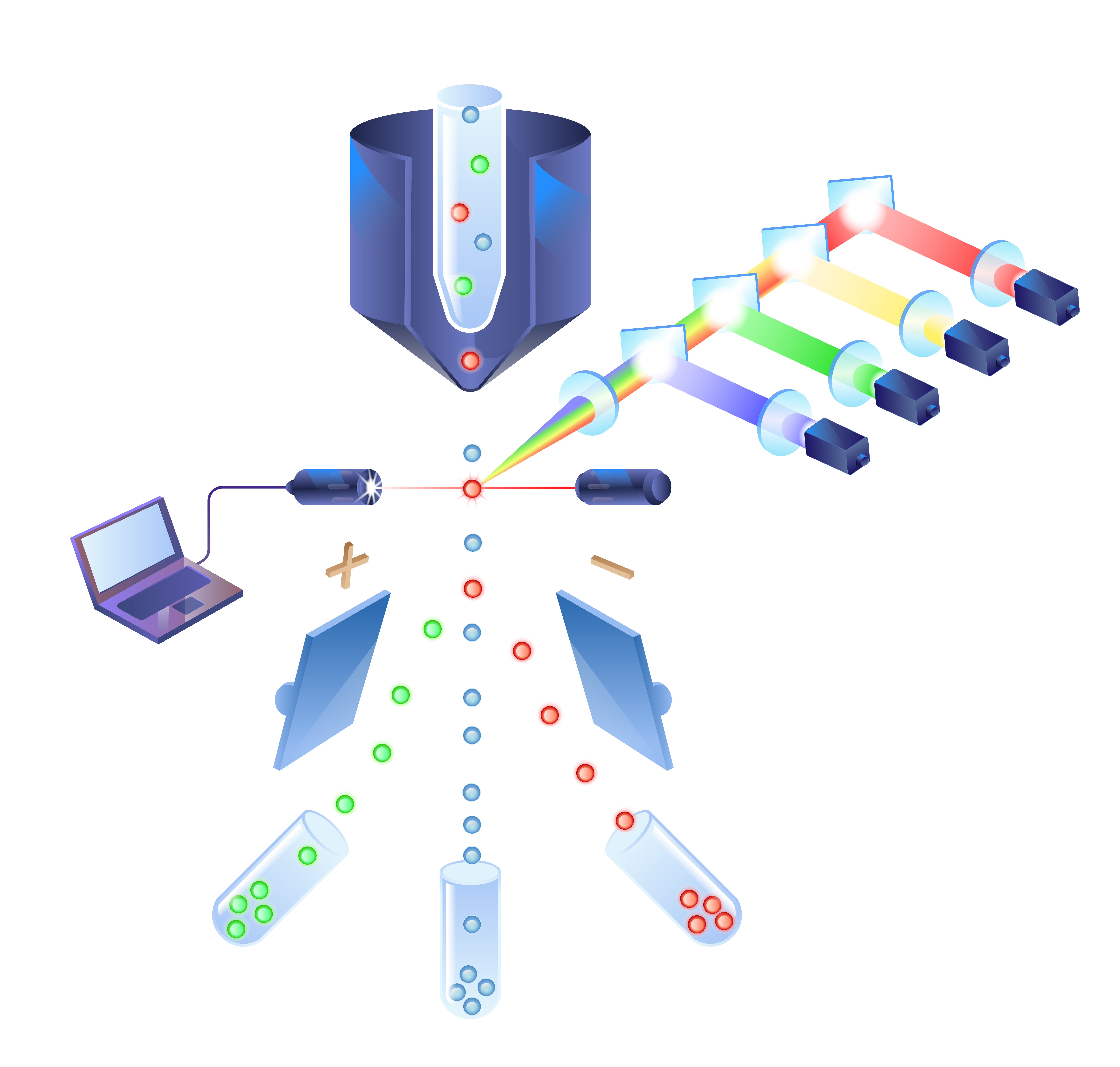
Key Components:
Lasers: Stimulate fluorescently labeled markers to emit signals on the cells.
Optical Detectors: Observe and measure the fluorescence and light scattering to estimate the size, granularity, and density of markers in the cell population.
Electrostatic Sorting System: This separates the flow of cells into droplets, charges target cells, and guides them into suitable collection tubes.
Step-by-Step Process:
Cell Preparation: With the help of Fluorescent dyes or antibodies that specifically target surface or intracellular components.
Laser Interrogation: When cells flow through the flow cytometer, lasers activate the fluorescent labels, and the detectors capture emitted spectra.
Droplet Formation: This constant flow of cells is now divided into separate droplets, each containing one cell.
Sorting: Electric charges affect the movement of the droplets carrying target cells into collecting receptacles.
Applications
FACS is widely used in various areas of research:
Immunology and Oncology: FACS isolates human immune cells, such as T cells and natural killer cells, and is used in cancer immunotherapy and vaccine research.
Genomic Studies: Since single-cell RNA sequencing involves the identification of specific cell populations for further molecular analysis, FACS is utilized to obtain highly purified cell populations.
Cell Cycle Analysis: It further noted that FACS can measurably detect other cellular functions, including proliferation, apoptosis, and differentiation.
Advantages
High Specificity: This is possible due to FACS, which provides more than one parameter, allowing the determination of cell size, granularity, and the different markers on each cell.
Versatility: Regarding the type of sample it can handle, it can work with blood, tissue, and cultured cell samples.
Rare Cell Isolation: Another strength of FACS is that it efficiently sorts out minority populations of cells.
Limitations
Cost: FACS and its operating reagents are costly, which makes this technique a significant investment in laboratories.
Technical Complexity: The method is sensitive to the operator's skill and the careful calibration of equipment.
Sample Size Requirements: Large parental cell populations are sometimes desirable for the most significant improvement in results.
Understanding MACS Technology
How It Works
MACS (Magnetic Activated Cell Sorting) is a simple and cost-effective method compared to FACS. This method involves using magnetic beads conjugated with antibodies that target particular cell markers; the cells are then sorted under the influence of an external magnetic field.

Process Overview:
Magnetic Labeling: The target cells are labeled with magnetic beads decorated with antibodies or ligands that have a preference for them.
Magnetic Separation: These labeled cells are captured in a column within a magnetic field while the rest are washed away.
Elution: The labeled cells are retrieved by eliminating the magnetic field around the tube.
Selection Methods:
Positive Selection: Target cells with labels are preserved and harvested.
Adverse Selection: The unwanted cells are eliminated, and the target population remains.
Applications
MACS has several critical applications:
T-Cell Therapy: It also increases the number of T-cells for immunotherapy and research into autoimmune diseases.
Pre-Enrichment for FACS: MACS reduces the complexity of FACS sample processes and improves the target cell population with simple techniques.
Hematology: One of the most critical applications of this technology is MACS, mainly the enhancement of hematopoietic stem cells for bone marrow transplants.
Advantages
Ease of Use: The procedure is simple and brief, which implies that anybody who conducts academic research can use it.
Affordability: It was revealed that MACS is significantly more cost-effective to operate than FACS since it uses relatively more affordable equipment and consumables.
Scalability: It is beneficial when large volumes of cells have to be separated, such as when isolating stem cells for use in regenerative medicine.
Limitations
Lower Resolution: Unlike FACS, MACS cannot differentiate well between cells with close phenotypic characteristics.
Marker Dependence: The method's effectiveness depends on the availability of recognizable surface markers, making it suitable only for specific cell types.
Comparing FACS and MACS
Although both FACS and MACS are helpful in cell sorting, their functions make them ideal for various applications.
Strengths:
FACS: Large magnification, multiple characteristics measurement, and limited cell identification.
MACS: Efficiency, speed, and low cost.
Weaknesses:
FACS: This approach's significant limitations are its high costs, complexity, and the requirement of large sample sizes for analysis.
MACS: Restricted in their ability to sort to the phenotypic level and less able to compare and distinguish between cells based on more subtle characteristics detected on the surface.
Complementary Use:
MACS is employed more frequently as a first step to enhance target populations by minimizing the levels of complexity before further analysis using FACS.
Key Considerations:
Thus, the applicability of FACS and MACS depends on the study's goals, the amount of budget that can be spent on equipment, and the required accuracy of sorting the cells.
Types of Instruments Used for FACS and MACS
Instruments for Fluorescence-Activated Cell Sorting (FACS)
FACS systems are sophisticated and versatile instruments that combine flow cytometry with sorting capabilities. Key components include:
- Flow Cytometers with Sorting Capabilities: These systems analyze and sort cells based on fluorescence signals and light scattering. Examples of advanced instruments include:
- BD FACSAria and FACSMelody series cell sorters
- Sony SH800 Cell Sorter
- Beckman Coulter MoFlo Astrios
- Lasers and Optics: High-powered lasers excite fluorescent markers, while detectors capture emitted light. Instruments may use multiple lasers to handle multicolor analysis.
- Electrostatic Cell Sorters: Integrated systems use electrostatic deflection to direct charged droplets containing target cells into collection receptacles.
- Automated Sample Handlers: Instruments such as BD FACSMelody often include automated sample loading and temperature control for better workflow efficiency.
- Software for Data Analysis: Flow cytometry instruments are equipped with specialized software (e.g., FlowJo, FCS Express) for real-time data acquisition and post-sorting analysis.
Instruments for Magnetic-Activated Cell Sorting (MACS)
MACS instruments are more straightforward compared to FACS systems but are effective for specific applications. Key tools include:
- Magnetic Cell Separators: These are compact devices that use strong magnets to hold labeled cells in specialized columns. Examples include:
- Miltenyi Biotec’s MACS Cell Separation Systems
- STEMCELL Technologies’ EasySep series
- Magnetic Beads: Superparamagnetic beads conjugated with antibodies or ligands target specific cell surface markers. These are critical consumables for MACS systems.
- Separation Columns: These columns are filled with matrices that trap magnetically labeled cells under the influence of a magnetic field.
- Automated Magnetic Separators: Advanced instruments, such as the autoMACS® Pro Separator from Miltenyi Biotec, automate the magnetic separation process, enabling high-throughput applications.
Real-World Applications of FACS and MACS
Immunology
Cancer Immunotherapy: FACS purifies antigen-specific T-cells for CAR-T treatments, and MACS concentrates lymphocytes for analysis.
Immune Profiling: is used to study the heterogeneity of immune cells in diseases such as HIV and autoimmune diseases.
Stem Cell Research
Differentiation Studies: FACS enables the brief separation of stem cells to evaluate the process of lineage-specific differentiation, assisting in regenerative medicine research.
Transplantation: MACS improves hematopoietic stem cells for bone marrow transplants by providing high yield and purity.
Drug Discovery
High-Throughput Screening: FACS allows isolating cells based on their response to drug candidates, speeding up therapeutic discovery.
Biomanufacturing: MACS allows for the enrichment of specific cells of interest for manufacturing biologics at a large scale.
Conclusion and Future Perspectives
In particular, FACS and MACS have revolutionized cell sorting in the studies of diverse cell types through cell identification, separation, quantification, and management. MACS has some disadvantages, such as lower resolution compared to FACS. Still, it also has advantages, which include easy use and low prices, making MACS appropriate for high-throughput screening and daily practice.
Future advancements in coupling FACS and MACS with cutting-edge technologies like AI and chip-based microfluidics will only improve the technologies. Potential evidence suggests that specific applications of AI technology enhance sorting precision and productivity. On the other hand, some microfluidic applications may decrease sample and reagent demands, thus making the technology more accessible.
As these technologies are constantly being further developed, research will become progressively more dependent on cell sorting, both in terms of improved methods and tangible results in medicine and interdisciplinary research fields.